
February 09, 2007
Stepping Down
After thinking it over for about a week, I have decided to end my blogging run. I have just lost the enthusiasm needed to do this two to three times a week. The Civil War, as it always has been and always will be, is a hobby for me. When that hobby begins to feel more like a job, I know it is time to step down. There are plenty of other great Civil War bloggers out there, including Drew Wagenhoffer, Eric Wittenberg, Dimitri Rotov, David Woodbury, and J.D. Petruzzi, to name only a few. I will continue to maintain all of my Civil War gaming sites and my Civil War book reviews site, where I still owe reviews to several University Presses and to author John Fox III. You can access all of my web site content at www.brettschulte.net, if you are interested of course. This site will remain up and the archives will be freely available to anyone who wants to take a look. Who knows, I may even recharge my batteries at some future date. I have no idea what the future holds, but I do know I'll be building a new house soon, so my blogging would have ended at that point anyway. Good luck to all of the current and future Civil War bloggers out there. I'll be reading!
February 08, 2007
The Complete Short Stories of Ambrose Bierce, Part 6
 |
The Complete Short Stories of
Ambrose Bierce
|
This is a recurring weekly series covering the short stories of Ambrose Bierce, Civil War veteran and well known satirist. This final entry in the series covers Bierce's tall tales. The author was present during quite a few fights and was greatly affected by the Civil War, especially "the crime at Pickett's Mill" during the Atlanta Campaign. In the Foreword, Cathy Davidson comments on Bierce's tall tales, saying:
[T]hese works, too, challenge generic boundaries and formal conventions. Employing the broadly exaggerated humor typical of tall tales, they create a vision of a grotesque, absurd world in a fashion that especially foreshadows the North American black humorists of the 1960's as well as the contemporary South American magic realists. These tales also illustrate most fully Bierce's suspicion that the ego is desperately committed to a refusal to recognize its own limitations and that pervasive social disorders such as prejudice, corruption, ad even war are not aberrations but logical extensions of the individual's incorrigible infatuation with the self.".Many of these Tall Tales are not online, making this book truly a must have for any Bierce fan.
NOTE: I have provided links to the various stories in this series. Simply left click on the title of each story to read it for yourself.
Part III: The World of Tall Tales
"An Imperfect Conflagration"
By Ambrose Bierce
Rating: 9/10
Quote: "The chief saw the force of these considerations; he was himself an assassin of wide experience."
Comments: A tongue in cheek tale of a man who murders his parents and does a pretty bad job covering it up.
"A Bottomless Grave" (not online)
By Ambrose Bierce
Rating: 8/10
Quote: "'There it is!--there it is!' she shrieked, pointing, 'God in heaven! can't you see it?'"
Comments: The narrator's "saintly" mother is closer to Ma Barker than Mother Theresa.
"The City of the Gone Away" (not online)
By Ambrose Bierce
Rating: 10/10
Quote: "...[N]ever again, Heaven helping me, would I earn an honest penny."
Comments: The narrator's "skill" as a physician leads to other business opportunities.
"Curried Cow" (not online)
By Ambrose Bierce
Rating: 9/10
Quote: "Every adult single male became at once a marrying man."
Comments: Aunt Patience's cow Phoebe enjoyed kicking everything she could find...until Mr. Huggins arrived.
"A Revolt of the Gods" (not online)
By Ambrose Bierce
Rating: 6/10
Quote: "It was indeed an ill-assorted and most unlucky alliance..."
Comments: An unhappy marriage leads to the destruction of a city.
"Oil of Dog"
By Ambrose Bierce
Rating: 10/10
Quote: "In short, I took ther first step in crime and brought myself untold sorrow by casting the babe into the cauldron."
Comments: A child's innocent act causes his mother and father to combine their occupations, but also has other consequences.
Part 1 - Part 2 - Part 3 - Part 4 - Part 5 - Part 6
Continue reading "The Complete Short Stories of Ambrose Bierce, Part 6"
February 05, 2007
Slight Blogging Interruption
I forgot to mention when I left on a trip on Friday that there will be a little bit of a blogging interruption until probably later this week. This was my first chance to get to a computer to let everyone know. If things go according to plan, I should have new material up on Thursday morning.
February 01, 2007
Beta Testers Wanted for Gary Grigsby's American Civil War
Beta testers are being solicited for Gary Grigsby’s American Civil War, based on the popular World at War game engine. Check it out HERE.
(Hat tip to Eddy Sterckx for the information.)
Today in the Petersburg Campaign
February 1, 1865
The troops in the trenches around Petersburg, VA, continue to suffer from the harsh winter weather as the James River threatens to freeze over.
Note: All "Today In The Petersburg Campaign" blog entries are used with permission from Ronald A. Mosocco's Chronological Tracking of the American Civil War per the Official Records of the War of the Rebellion. Order the book HERE.
Copyright © 1993, 1994 by Ronald A. Mosocco
January 31, 2007
AGEOD Launches A Web Site For Their Upcoming Civil War Game
AGEOD, designers of an upcoming Civil War computer game you may have seen once or twice on this blog (grin), have officially launched a new web site for the game. Check it out HERE. Initial offerings include "Overview & Gameplay", "Screenshots & Wallpapers", "Reviews & Community", and a link back to the main AGEOD web page. Links to buy the game and download a demo are coming soon. I'm starting to get pretty excited about this game. If it is anything like Birth of America in terms of ease of play and just plain fun it should be a big hit.
Today in the Petersburg Campaign
January 31, 1865
Gen. Robert E. Lee, CSA, is appointed General-in-Chief of all the Confederate Armies; a promotion too late in coming to have any effect.
Note: All "Today In The Petersburg Campaign" blog entries are used with permission from Ronald A. Mosocco's Chronological Tracking of the American Civil War per the Official Records of the War of the Rebellion. Order the book HERE.
Copyright © 1993, 1994 by Ronald A. Mosocco
January 30, 2007
Today in the Petersburg Campaign
January 30, 1865
Federal scout to Long Bridge and Bottom's Bridge, VA, the Richmond, VA, Campaign.
Note: All "Today In The Petersburg Campaign" blog entries are used with permission from Ronald A. Mosocco's Chronological Tracking of the American Civil War per the Official Records of the War of the Rebellion. Order the book HERE.
Copyright © 1993, 1994 by Ronald A. Mosocco
January 29, 2007
Beta Tester Starts New AAR for AGEOD's Upcoming Civil War Game
Many of you who read this blog regularly will be familiar with AGEOD's American Civil War, due out very soon. I went over various features being covered by lead developer "Pocus" in late December 2006. AGEOD beta tester "Barney" has started a new AAR for the game to give prospective buyers further insight into how the game works. "Barney's" first post in the ongoing AAR is as follows:
Hi all,Pocus asked me to post this AAR of the Bull Run campaign. Let me know what you think! I'll be posting a turn a day for the next week.
Barney
First Bull Run
Beta version 0.96
Early June 1861 and the war between the States, which officially began on 12 April 1861 with the attack on Fort Sumter, enters it’s third month without a major engagement having yet been fought. In Washington, Congressmen, Senators and the public clamour for the Federal government to strike quickly and move onto Richmond, the newly designated capital of the Confederate States of America. Republican President, Abraham Lincoln has appointed Brigadier General Irvin McDowell to command the Army of North-eastern Virginia. McDowell, a graduate of West Point and veteran of the Mexican-American war is reluctant to commit his untried and untrained Army, the largest ever assembled in North America, without the proper training and preparation. However after continued pressure from the Politicians, Citizens and the President, he reluctantly begins to draw up plans for an invasion of north-eastern Virginia. As the President reminds him "You are green, it is true, but they are green also. You are all green alike". The stage is now set for the opening of the first major battle in the eastern theatre of the American Civil War.
The President has told McDowell that the American people expect a quick victory and consequently expect nothing less than the capture of Richmond within three months. (Game note on scenario objective: The union player wins if he ends the scenario in sole control of Richmond or if he breaks the Confederate morale. Time allotted 6 turns)
Start of Scenario

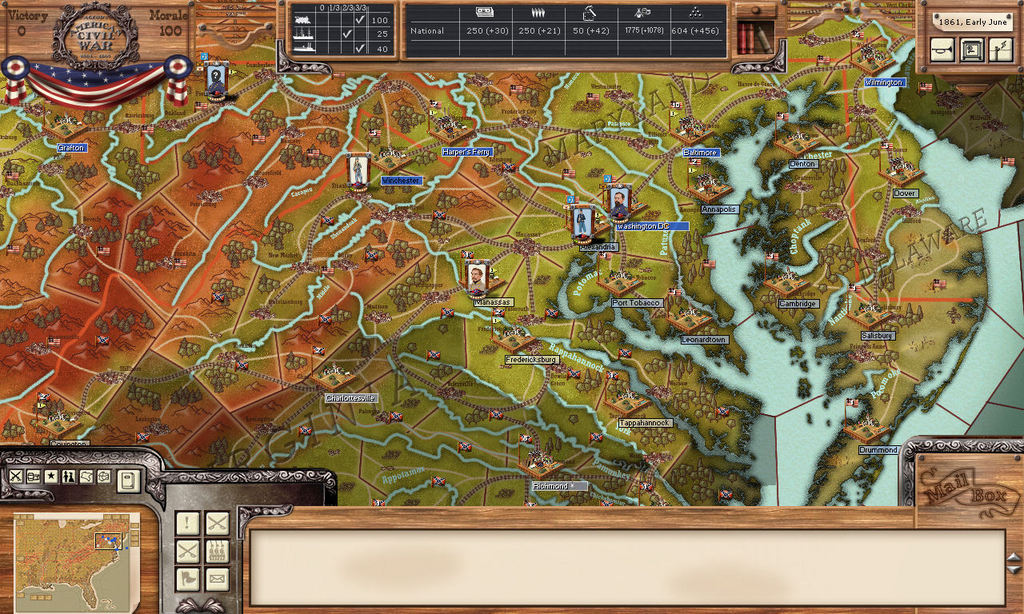
This is the extreme view of northeastern Virginia and southern Maryland. It allows a view of both capitals, where a large portion of the war will undoubtedly be fought.Game note: AACW’s map is a very good representation of both the Eastern and Western theatres of the American Civil War portraying accurately the counties, cities, towns, forts, rivers, islands, roads and railroads that became the major objectives of the campaigns of the civil war. As the game is still in beta, the map is still subject to change. This will probably include a respositioning of Manassas.
The range of mountains running up the length of the map in western Virginia are the Shenandoah Mountains. There are numerous gaps through the mountains, both road and rail, which will be important from a strategic perspective as it will allow rapid troop movement from the Shenandoah Valley to the north-eastern battlefields. Control of the gaps is of vital importance, especially in the north where the Baltimore and Ohio Railroad allows for rail movement from Cumberland, Md to Harpers Ferry, Va. and the quick movement of troops across the theatre. Across the Maryland border from the town of Harper’s Ferry is Winchester, a strategic crossroads allowing for travel into western and eastern Virginia. Whilst rebel troop dispositions are incomplete due to the fog of war a large body of Confederates are known to be just south of Winchester clearly threatening Harper's Ferry.
South-east of Washington is the rail hub at Manassas Junction, where the Manassas Gap RR meets the Orange and Alexandria RR. McDowell knows it’s an important objective on the road to Richmond as denial of the railroad to the rebels will reduce their inability to move troops quickly around the theatre. It’s possession should open the way to Richmond. Unfortunately the hero of Fort Sumter P.G.T Beauregard, commander of the Confederate Army of the Potomac (5-1-3) also appreciates this fact and is directly opposing any movement down the O&A.
As for Union dispositions, in the extreme north-east on the other side of the Shenandoah Mountains is Brigadier General Robert Patterson (2-1-1) with two divisions, and in Washington and Alexandria are the main body of the Army of Northeastern Virginia (35,000 men), comprising 5 divisions.
Game note: There’s a lot of detail in Ageod’s ACW. If you don’t believe me take a look at the feature of the day mammoth thread. Each historic division, brigade and regiment is detailed in the game (refer above screenshot).
Continue to follow the AAR HERE.


